


Exchange traded funds have become more popular over the years at the expense of mutual funds. Unlike mutual funds that trade once a day, exchange traded funds trade like stocks, and are essentially baskets of stocks, bonds, or other assets. They are also more tax efficient than mutual funds, as investors only pay capital gains tax on sale of the ETF. One is not subject to an annual distribution tax on net assets sold from within the fund, as is the case with mutual funds. Most ETFs track passive indices, although more creative products such as active or levered ETFs are also becoming more available.
As for any asset class, ETFs are also subject to their own set of risks, hence we will focus on two main topics here:
- Key selection criteria – including red flags
- How we use ETFs in our client portfolios
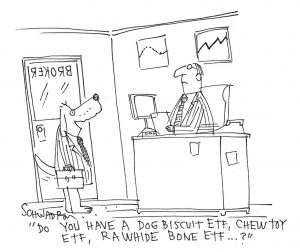
Key Characteristics and Selection Criteria – it is important that:
The ETF can invest completely in the underlying asset
This is not always possible for many bond funds owing to the over-the-counter nature of the market – for example, a bond ETF may not hold each security that is part of the index. The same holds true for some small cap equity ETFs.
The ETF is indeed a good proxy for the theme it is claiming to represent, especially when advertised as a sector ETF.
For example, an early Blockchain ETF simply gave investors access to large cap tech-oriented companies that had a small part of their business focused on the area, even if most of their activity was elsewhere. Thus, the ETF was not significantly differentiated from other general large cap ETFs.
There is adequate daily float and liquidity in the ETF
We prefer as a rule that the ETF have assets of at least $100 million and a trading volume of several tens of thousands of shares per day.
There is robust security selection criteria and methodology
This allows for rebalancing and exclusion of companies that no longer meet the key criteria. For example, certain growth-oriented ETFs may require maintenance of a particular growth rate in sales or earnings. Similarly, classic dividend growth ETFs will exclude companies that do not continue to increase their dividend every year.
Often ETFs are benchmarked to an index that is created, and it is the index that is rebalanced according to the set criteria.
There is strong sponsorship of the ETF by a reputable product provider
Most of the larger and medium- sized niche ETF providers have product specialists who provide us additional information and insights into the ETFs they offer.
We hold regular research calls with these professionals, who give us a sense of which ETFs are popular and growing, identify any rebalancing that has been done, and relay to us any relevant flow of funds information.
In other words, we do not advocate investing in “dumb” or totally passive indices. This has been evidenced recently where a couple of ETFs which held large positions in stocks that rose exponentially because of a short squeeze, were themselves subject to wild price gyrations.
We avoid levered ETFs – they are not mirror images of their unlevered counterparts. We prefer to simply hold a larger position in the underlying ETFs. This is a whole different discussion, but suffice it to say that, for example, an ETF which promises to provide three-times the daily return of the NASDAQ, will not be able to do so over time.
How We use ETFs primarily
Core Equity Holdings
For more conservative and moderate risk clients, we focus on dividend growth ETFs. They do not necessarily pay the highest dividend but do raise them consistently.
Why? We believe that the underlying companies in each dividend growth ETF tend to be of very high quality with the ability to generate strong and consistent cash flow. And they can provide some yield for the portfolio.
Access to New Areas and Growth Industries
Sector ETFs can be an efficient and exciting way to gain access to growing industries and sub sectors. Mutual funds tend to be more diversified and less sector focused.
Moreover, in today’s market environment, exposure to a sector via ETFs may be more efficient than picking individual stocks. It is hard to predict which stock in a particular sector will outperform its competitors – and they often may do so for the wrong reason – or be the target of a misplaced merger. Hence, we like the idea of exposure to a discreet basket of stocks in the sector or sub-sectors. Below are a few illustrative examples, which fall into two main themes:
“Work and play from home” – e-commerce, cloud computing, remote communication and related connectivity, cybersecurity, 5G, e-gaming, block chain technologies.
“Finding the cure” – biotech, pharma, cannabis, etc.
Other areas of interest include machine learning, green energy, and international e-commerce.
There are cases where ETFs do not make sense as there are not enough companies in the sector. For example, one ETF focused on the Lithium product cycle has become dominated by Tesla. One may as well simply own Tesla. On the other hand, an ETF focused only on lithium mining would not make sense as it would be dominated by two companies. So, there are cases where instead of an ETF, an investor may prefer to purchase a few key stocks.
Active ETFs
This is a new and developing category, which allows managers full discretion in buying and selling securities – like a mutual fund. With one or two exceptions, we are not focused on this area yet. However as seen above, we do focus on rules-based ETFs which include selection criteria that allow for regular rebalancing and for the pruning of companies that no longer meet the desired criteria.
In summary
Exchange traded funds provide a tax efficient way to gain equity exposure to one’s portfolio. However, it is important to monitor each ETF and not look at them as a purely passive strategy. Robustness of the end product is key, as is oversight in order to see that each ETF remains loyal to its mandate.
If you would like to receive our updates, please sign up for the Nardis Advisors newsletter.
SUBSCRIBE to the Nardis Advisors YouTube channel or ongoing updates related to the markets, economy, and finance for expats.
CONTACT US to schedule a time to speak with Nardis Advisors regarding your portfolio and personal financial plan.
Norman H. Chait, CFA Managing Principal, Nardis Advisors LLC, January 30th, 2021
Disclaimer: Nardis Advisors LLC (“Nardis”) is a Registered Investment Advisory Firm regulated by the U.S Securities and Exchange Commission in accordance and compliance with applicable securities laws and regulations. Nardis does not render or offer to render personalized investment advice through this medium. The information provided herein is for informational purposes only and does not constitute financial, investment or legal advice. Investment advice can only be rendered after delivery of the Firm’s disclosure statement (Form ADV Part 2) and execution of an investment advisory agreement between the client and Nardis.
Subscribe to Our Newsletter
Stay up to date and receive the latest from Nardis, with resources such as our monthly blog and access to complimentary webinars.-
 August 18, 2026|
- Expats
- |
- Investing
The Three Times U.S. Expats Need Access to Their Money MostYou’ve spent years building your wealth. But have you ever stopped to ask a simple question: Will you, and your family, be able to access it when it matters most? For many U.S. expats, the biggest risks aren’t poor investment returns. They’re the unexpected obstacles that can arise when you move overseas, lose the ability… -
 June 16, 2026|
- The Dreidel
The Dreidel –June 2026 EditionDear fellow practitioners, CPAs, attorneys, and other professionals, welcome to the twentieth edition of our “Dreidel” newsletter about planning and investment issues of US citizens living overseas. This month Mike Reed will cover a little-known Social Security rule that could have a large impact for couples living in Israel – specifically for couples where one… -
 April 17, 2026|
- Case Studies
- |
- Expats
Discovering the Retirement Account of a Deceased SpouseWe welcomed a new client who had moved back to Israel from the US after the passing of her husband. Morgan Stanley could no longer hold her Individual Retirement Account (IRA). We transferred this to Pershing, our primary custodian and began to manage the account. The couple had worked for over ten years in the… -
 April 17, 2026|
- Case Studies
- |
- Expats
The Tale of the Gold BarsWe welcomed a new client in 2025, who is a US citizen living in Israel, following the retirement of her 95-year old advisor. The majority of the assets are custodied with one of our current custodians, so no asset transfer was necessary. However, the client noted that she holds some physical gold bars in storage…
Explore More Articles
-
 April 16, 2026|
- Articles
- |
- Expats
13 Social Security Facts For 2026In the spirit if the penultimate song in the Passover Haggadah, here is a fresh look at some key aspects of Social Security for US expats living in Israel. But first, if you’re new to life in Israel, check out our other helpful reads on moving abroad, cross-border finances, and tax-smart planning for expats: What… -
 April 15, 2026|
- Articles
- |
- Expats
Kicked Out of Your US Brokerage Account? Here’s What You Can Do:Can I continue to hold my US brokerage and retirement accounts once I leave the US to move overseas ? The good news is that in principle, not only can you keep your US brokerage account with a US bank or custodian, but in most circumstances it makes sense to do so, especially in the… -
 March 28, 2026|
- Articles
- |
- Expats
Can I Afford to Retire in Israel? – Key Questions, Answers and Insights Living in Israel as an American ImmigrantOn February 25 Webinar we held a Webinar entitled “Can I Afford to Retire in Israel”. The panel consisted of Rifka Lebowitz– “Living Financially Stronger in Israel”, Marci and David Eskenazi- “The Aliyah Network”, alongside Norman Chait and Mike Reed of Nardis Advisors. Here is a summary of the issues that were most important to…