

As we close out 2025, it’s time to prepare your finances for the new year.
For U.S. expats, whether you’re living in Israel, France, or anywhere else abroad, year-end is an ideal moment to reduce your tax burden, shore up compliance, and position your investments for 2026.
But first, if you’re new to life in Israel, check out our other helpful reads on moving abroad, cross-border finances, and tax-smart planning for expats:
What to do when you get kicked out of your US brokerage account
Can one use a US Power of Attorney in Israel, (and vice versa)?
Checklist for moving to Israel
Financial planning for US citizens living abroad
Selling a house in Israel as a US citizen
Why US Expats should look before they leap into a Roth 401k
Compliance with reporting of foreign assets: tips for US expats to avoid stress
What expats need to know about Brokerage Accounts for non-US residents
And now let’s get into the blog!
Here are some top items to review before the clock strikes midnight:
1. Realize Losses and Gains Strategically
Year‑end is the ideal time to review your investment portfolio for tax efficiency. If you have positions that are down, consider tax‑loss harvesting to offset realized capital gains.
And for Americans living in Israel under the 10‑year tax exemption on foreign investment income, timing is especially important: loss carry‑forwards can only be used within that 10‑year window.
If you’re sitting on unrealized gains, you may even choose to sell and immediately repurchase profitable positions, locking in gains now so they can offset losses before the exemption period ends.
2. Set Aside Tax Payments Early
Even if you plan to file for an extension, your 2025 taxes must still be paid, nearly in full, by April 15, 2026 to avoid penalties and interest.
Don’t get caught off guard by an unexpected bill. Forecast your liability now and reserve the funds accordingly.
3. Revisit Your Retirement Contributions Before the Year Closes
Review how much you can contribute to your IRA, SEP-IRA, or Solo 401(k), especially if you’re self-employed or have U.S. source income.
A cross-border financial advisor can help ensure you’re taking full advantage of what’s available while avoiding contribution errors.
4. Don’t Miss Your Required Minimum Distributions (RMDs)
If you’re 73 or older, or have inherited an IRA, you’re required to take your RMD by December 31. Failing to do so can result in steep IRS penalties.
For U.S. expats, the good news is you don’t need to transfer the funds overseas. Simply moving the correct amount into your U.S. brokerage account counts as fulfilling the requirement.
Keep in mind: RMDs count as fully taxable income for the 2025 tax year.
5. Review Your Social Security Credits
To qualify for the U.S. Social Security benefits, you need 40 credits, typically one for each quarter worked, adding up to 10 years.
If you’re currently short, you still have time. You can earn up to four additional credits in 2025 based on eligible income.
For many expats, this is a critical step toward securing future benefits, so don’t overlook it.
6. Update Your Beneficiaries
Life changes, like marriage, divorce, relocation, or the birth of a child, can impact your long-term intentions.
That’s why year-end is a smart time to review and update beneficiaries across key documents and accounts, including:
- Wills and trusts
- IRAs and 401(k)s
- Life insurance policies
Even a small oversight can create complications later. Keeping beneficiary designations current ensures your assets go where you intend, without delays or disputes.
7. Understand and Monitor Your Tax Residency Status
If you’re a U.S. expat living abroad, spending too many days back in the States could unintentionally trigger the Substantial Presence Test (SPT), which may reclassify you as a U.S. tax resident, with global tax implications.
Even if you consider yourself a non-resident for lifestyle or visa reasons, the IRS may disagree if your physical presence exceeds certain thresholds.
If you’re approaching the limit, consult a cross-border tax advisor to explore elections or planning moves that preserve your non-residency status.
8. Secure and Organize Proof of Income
Whether you’re self-employed, a freelancer, or running a business overseas, make sure your income records are clean and accessible.
Up-to-date invoices, bookkeeping entries, and financial statements are often requested by tax authorities, lenders, and immigration offices.
A little year-end housekeeping now can prevent delays, or denials, later.
9. Prepare Early for FATCA and FBAR Filing
If you hold foreign financial accounts, such as bank, pension, or investment accounts, now’s the time to get organized.
U.S. citizens abroad must often report these under FBAR (FinCEN Form 114) and FATCA (Form 8938).
To stay compliant, gather your year-end balances and any necessary account details before December 31. Starting early ensures fewer surprises during tax season.
Need Help Navigating Year-End Decisions?
Managing cross-border finances as a U.S. expat is anything but straightforward, from optimizing tax strategies and retirement distributions to ensuring compliance with FATCA and FBAR.
That’s where Nardis comes in. Our team specializes in helping Americans abroad make informed, compliant, and tax-efficient financial decisions tailored to their unique residency, income sources, and long-term goals.
Whether you need guidance on U.S.-Israel tax coordination, Social Security planning, or retirement structuring, Nardis offers the clarity and confidence you need to enter the new year financially secure.
Contact us today to schedule a personalized consultation
JOIN our newsletter here to stay informed.
Disclaimer
Nardis Advisors LLC (“Nardis”) is a Registered Investment Advisory Firm regulated by the U.S Securities and Exchange Commission in accordance and compliance with applicable securities laws and regulations. Registration does not imply a certain level of skill or training. Nardis does not render or offer to render personalized investment advice through this medium. The information provided herein is for informational purposes only and does not constitute financial, investment or legal advice. Investment advice can only be rendered after delivery of the Firm’s disclosure statement (Form ADV Part 2) and execution of an investment advisory agreement between the client and Nardis.
Subscribe to Our Newsletter
Stay up to date and receive the latest from Nardis, with resources such as our monthly blog and access to complimentary webinars.-
 March 28, 2026|
- Articles
- |
- Expats
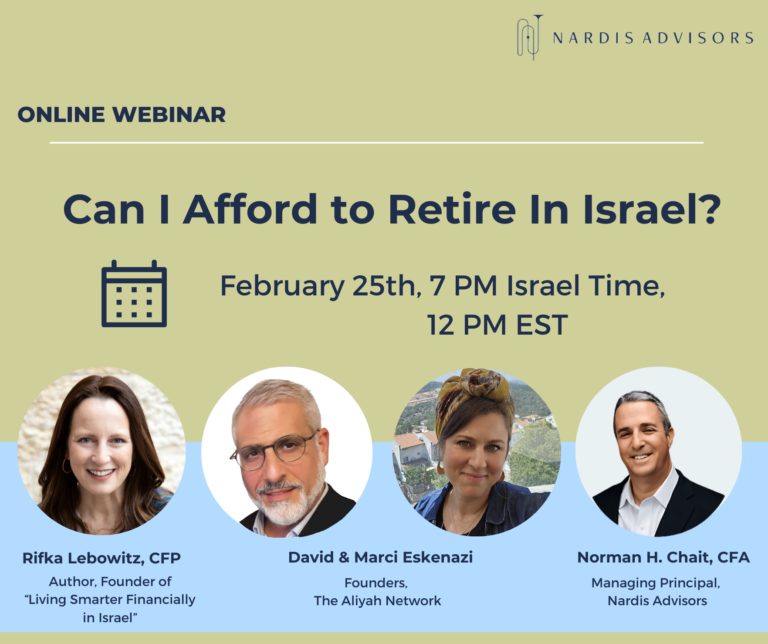
Can I Afford to Retire in Israel? – Key Questions, Answers and Insights Living in Israel as an American ImmigrantOn February 25 Webinar we held a Webinar entitled “Can I Afford to Retire in Israel”. The panel consisted of Rifka Lebowitz– “Living Financially Stronger in Israel”, Marci and David Eskenazi- “The Aliyah Network”, alongside Norman Chait and Mike Reed of Nardis Advisors. Here is a summary of the issues that were most important to… -
 February 10, 2026|
- Articles
- |
- Expats
Living in Israel as an American ImmigrantI’m a U.S. citizen and investment advisor who spent 23 years in New York building a business, Nardis Advisors, that’s still proudly headquartered there. But in 2016, I made the move back to Israel for deeply personal and family reasons. This article isn’t about urging you to pack up and move tomorrow. It’s simply a… -
 January 29, 2026|
- Articles
- |
- Expats
Should You Worry About the Strong Shekel? A Financial Reality Check for Americans Making AliyahMoney moves emotions, and nothing seems to stir those emotions more than exchange rates. Lately, many of my American clients eyeing a move to Israel, or preparing to transfer funds here, are alarmed by the shekel’s recent rally. A year ago, the dollar hovered around ₪3.60–3.70. Today, it’s near ₪3.09. That’s a 15% appreciation of… -
 January 5, 2026|
- Articles
- |
- Expats
What To Do When You Get Kicked Out of Your US Brokerage Account – 2026 UpdateLet’s face it, no one likes being kicked out of the club or the popular group. Whether it was the cool kids’ lunch table or the popular country club, no one is a fan of being excluded. One area where this is happening more frequently in 2026 is for U.S. expats living abroad who are…
Explore More Articles
-
 November 25, 2025|
- The Dreidel
The Dreidel –November 2025 EditionDear fellow practitioners, CPAs, attorneys, and other professionals, welcome to the nineteenth edition of our “Dreidel” newsletter about planning and investment issues of US citizens living overseas. This month Mike Reed discusses Qualified Charitable Contributions. On Required Minimum Distributions (RMDs): As 2025 comes to a close, many people with retirement accounts start thinking about Required… -
 November 7, 2025|
- Articles
- |
- Expats
Heading Into 2026: How the Strengthening Shekel Is Reshaping Life for American OlimThe cost of living in Israel has always been a key concern for American Olim. And as we move closer to 2026, many are feeling the effects of a major financial shift, one that could impact your daily spending, retirement planning, and overall financial wellbeing. Unlike the favorable trends of 2023, where the dollar was… -
 September 17, 2025|
- Articles
- |
- Case Studies
- |
- Expats
Treatment of Inherited IRAs: A Guide for U.S. ExpatsYou’ve just inherited an Individual Retirement Account (IRA) from a loved one in the U.S., and while the asset itself is meaningful, what follows can feel like a maze of tax rules, distribution deadlines, and financial red tape. If you live abroad, the challenge is even greater. Suddenly, U.S. tax laws collide with foreign reporting…