


In the spirit if the penultimate song in the Passover Haggadah, here is a fresh look at some key aspects of Social Security for US expats living in Israel.
But first, if you’re new to life in Israel, check out our other helpful reads on moving abroad, cross-border finances, and tax-smart planning for expats:
What to do when you get kicked out of your US brokerage account
Can one use a US Power of Attorney in Israel, (and vice versa)?
Checklist for moving to Israel
Financial planning for US citizens living abroad
Selling a house in Israel as a US citizen
Why US Expats should look before they leap into a Roth 401k
Compliance with reporting of foreign assets: tips for US expats to avoid stress
What expats need to know about Brokerage Accounts for non-US residents
And now let’s get into the blog!
- Eligibility is the same as for in the US. You need forty quarters of income to be qualified.
- Your top 35 years of earnings, adjusted for inflation, are taken into account in determining your eventual monthly payout. If you only worked 17.5 years, the zero earning years will be factored in and you will only be eligible for half the benefit of someone who worked for 35 years or more.
- You do not lose your Social Security eligibility once you leave the US.
- You will have to continue contribute to Social Security (and accrue Social Security credits) if you are a business owner or sole proprietor in Israel. Employees based in Israel are exempt.
- Social Security and Israel National Insurance (Bituah Leumi), are two totally separate systems, that do not affect each other. You may in many situations pay into both.
- As of 2026 US immigrants to Israel are now exempt from paying Bituah Leumi for the first five years after Aliyah, if they pay continue to pay US Social Security.
- You may claim Social Security between ages 62 and 70. However each year you wait, you get a higher amount. This may be 76% more at age 70 than at age 62. The break even (less for longer versus more for less time) is around age 82. So life expectancy is a key factor in deciding when to claim.
- A lesser-earning spouse may claim the larger of their own Social Security amount, or up to half of that of their higher earning partner at the latter’s full retirement age (67 in most cases). Once one partner passes away the widow(er) is entitled to the higher of the two amounts as a survivor benefit.
- Non-US citizen spouses may be eligible for spousal Social Security benefits if they lived with their US citizen partner in the US for at least five years.
- The last two points also apply to divorcees who were married to their former spouses for at least ten years
- Social Security is Tax-Free for Israel residents, both in the US and in Israel, according to the US-Israel Tax Treaty. This is a key factor in determining how to maximize your Social Security earnings.
- For people in their mid-to-late sixties, who have been in Israel for less than ten years, the current US tax credits for seniors make it worthwhile to take early retirement distributions, instead of claiming Social Security earlier. This will allow for a higher tax-free Social Security payment later on (one has to claim by age 70).
- You may receive your monthly Social Security payment in shekels directly to your Israeli bank account. The exchange rate is decent.
Social Security is an excellent savings medium, and should be looked upon as such. As a rule of thumb, look at it as you would evaluate a private equity investment. In other words, see how much you paid into the system, and divide your monthly payment into that amount to see how long it takes to break even. Everything above that is tax-free profit that continues as long as you are alive (plus survivor benefits for your lesser earning partner if he/she outlives you).
Many of the rules are complex, so contact us to discuss eligibility and to plan a strategy when to claim. The latter should take your retirement distributions into account in order to optimize your taxes. We have highly qualified experts on call. Please reach out for a free 15-minute consultation if relevant.
Thinking About Moving to Israel?
You don’t have to make a radical, all-or-nothing decision overnight. But if the idea has been on your mind, we’re happy to chat.
Whether you’re:
- Planning retirement in Israel,
- Exploring dual-continent work,
- Or just curious what the day-to-day is like here,
…feel free to reach out. We’ve also published the following blogs you might find helpful:
Let’s Talk!
We’re financial advisors for expats, both in the U.S. and in Israel, and can help you plan your transition wisely. Whether you’re balancing U.S. assets, managing remote income, or figuring out healthcare and retirement, we’ve helped dozens do just that.
If you are moving to Israel or another country and don’t know where to start when it comes to the financial side of things, please contact us.
If you would like to receive our updates, please sign up for the Nardis Advisors newsletter to stay informed.
SUBSCRIBE to the Nardis Advisors YouTube channel or ongoing updates related to the markets, economy, and finance for expats.
CONTACT US to schedule a time to speak with Nardis Advisors regarding your portfolio and personal financial plan.
Disclaimer
Nardis Advisors LLC (“Nardis”) is a Registered Investment Advisory Firm regulated by the U.S Securities and Exchange Commission in accordance and compliance with applicable securities laws and regulations. Registration does not imply a certain level of skill or training. Nardis does not render or offer to render personalized investment advice through this medium. The information provided herein is for informational purposes only and does not constitute financial, investment or legal advice. Investment advice can only be rendered after delivery of the Firm’s disclosure statement (Form ADV Part 2) and execution of an investment advisory agreement between the client and Nardis.
Subscribe to Our Newsletter
Stay up to date and receive the latest from Nardis, with resources such as our monthly blog and access to complimentary webinars.-
 August 18, 2026|
- Expats
- |
- Investing
The Three Times U.S. Expats Need Access to Their Money MostYou’ve spent years building your wealth. But have you ever stopped to ask a simple question: Will you, and your family, be able to access it when it matters most? For many U.S. expats, the biggest risks aren’t poor investment returns. They’re the unexpected obstacles that can arise when you move overseas, lose the ability… -
 June 16, 2026|
- The Dreidel
The Dreidel –June 2026 EditionDear fellow practitioners, CPAs, attorneys, and other professionals, welcome to the twentieth edition of our “Dreidel” newsletter about planning and investment issues of US citizens living overseas. This month Mike Reed will cover a little-known Social Security rule that could have a large impact for couples living in Israel – specifically for couples where one… -
 April 17, 2026|
- Case Studies
- |
- Expats
Discovering the Retirement Account of a Deceased SpouseWe welcomed a new client who had moved back to Israel from the US after the passing of her husband. Morgan Stanley could no longer hold her Individual Retirement Account (IRA). We transferred this to Pershing, our primary custodian and began to manage the account. The couple had worked for over ten years in the… -
 April 17, 2026|
- Case Studies
- |
- Expats
The Tale of the Gold BarsWe welcomed a new client in 2025, who is a US citizen living in Israel, following the retirement of her 95-year old advisor. The majority of the assets are custodied with one of our current custodians, so no asset transfer was necessary. However, the client noted that she holds some physical gold bars in storage…
Explore More Articles
-
 April 15, 2026|
- Articles
- |
- Expats
Kicked Out of Your US Brokerage Account? Here’s What You Can Do:Can I continue to hold my US brokerage and retirement accounts once I leave the US to move overseas ? The good news is that in principle, not only can you keep your US brokerage account with a US bank or custodian, but in most circumstances it makes sense to do so, especially in the… -
 March 28, 2026|
- Articles
- |
- Expats
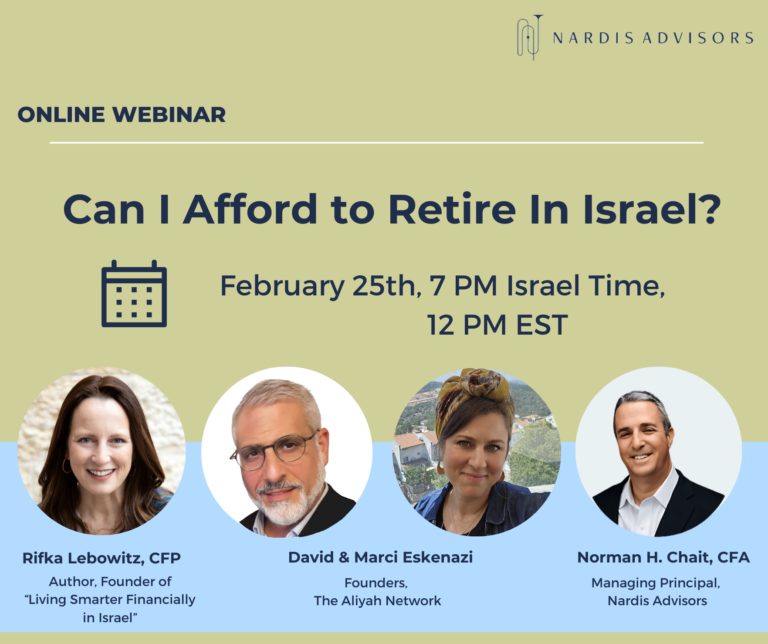
Can I Afford to Retire in Israel? – Key Questions, Answers and Insights Living in Israel as an American ImmigrantOn February 25 Webinar we held a Webinar entitled “Can I Afford to Retire in Israel”. The panel consisted of Rifka Lebowitz– “Living Financially Stronger in Israel”, Marci and David Eskenazi- “The Aliyah Network”, alongside Norman Chait and Mike Reed of Nardis Advisors. Here is a summary of the issues that were most important to… -
 February 10, 2026|
- Articles
- |
- Expats
Living in Israel as an American ImmigrantI’m a U.S. citizen and investment advisor who spent 23 years in New York building a business, Nardis Advisors, that’s still proudly headquartered there. But in 2016, I made the move back to Israel for deeply personal and family reasons. This article isn’t about urging you to pack up and move tomorrow. It’s simply a…