


Retirement abroad can mean a new country, a different lifestyle, and perhaps a lower cost of living. But while you may be ready to cross borders, much of your retirement money may remain firmly connected to the United States.
Your Social Security benefits, old 401(k)s, and IRAs don’t simply disappear when you move. What can change is how you access them, how they’re managed, and how they’re taxed.
That makes knowing what you own and how the rules apply to you an important part of preparing for retirement overseas.
Your Retirement Money Can Follow You, but the Rules May Change
Start by taking inventory. Where are your retirement accounts held? Do you have savings sitting in a former employer’s plan? What benefits have you earned, and will moving abroad affect them?
For Americans who have worked in several countries, the picture can become even more complicated. You might have Social Security benefits in the U.S., an old 401(k) from a previous employer, and a pension in your current country of residence.
If you’re considering Israel, for example, understanding the broader financial considerations for Americans retiring to Israel can help you prepare for these cross-border issues.
The good news is that moving abroad doesn’t mean giving up what you’ve already earned. But there are a few questions worth answering before you pack your bags.
Three Retirement Questions U.S. Expats Frequently Ask
Does Moving Abroad in Retirement Actually Reduce My Social Security Check?
No. Moving abroad does not reduce the Social Security benefit you’ve earned.
There’s also good news for retirees with foreign pensions. The Social Security Fairness Act ended the Windfall Elimination Provision and Government Pension Offset. For benefits payable from January 2024 onward, these provisions no longer reduce Social Security benefits for people receiving pensions from work not covered by Social Security, including certain foreign pensions.
Moving isn’t the only way retirement money can get complicated, though. Sometimes the bigger problem is simply finding it.
How Do I Find Retirement Money I Left Behind When I Changed Jobs or Countries?
Start with an old statement. It should identify the plan administrator you can contact about your account. If you don’t have one, call your former employer and ask who administered the retirement plan.
You can also search the U.S. Department of Labor’s Retirement Savings Lost and Found database for certain private-sector workplace retirement plans.
Once you locate an old 401(k), you can determine whether keeping it there or rolling it into an IRA makes sense. For expats, this decision deserves particular care because some U.S. custodians restrict accounts after you move overseas.
But what if you’re not just changing countries? What if you’re changing citizenship?
What Happens to My 401(k) or IRA If I Renounce U.S. Citizenship?
Renouncing U.S. citizenship does not mean giving up your 401(k) or IRA. Those investments still belong to you.
What can change is their tax treatment and the amount withheld when you take distributions. Your situation may depend on your tax residence, account type, and whether you’re considered a “covered expatriate.” The IRS rules for expatriation and retirement accounts include special treatment for certain deferred compensation and tax-deferred accounts.
That’s why understanding the tax consequences before renouncing citizenship is particularly important.
Take Your Retirement Plan With You
Your address, employer, and even citizenship may change, but the retirement wealth you’ve accumulated doesn’t simply vanish. What changes are the rules surrounding it.
Before making a major international move, take inventory of your retirement assets and understand how you’ll access and manage them abroad.
At Nardis Advisors, we help Americans living overseas navigate their U.S. investments and retirement planning so their finances can move with them. If you have questions about your retirement assets abroad, schedule a consultation with Nardis Advisors to discuss your financial needs.
Disclaimer
Nardis Advisors LLC (“Nardis”) is a Registered Investment Advisory Firm regulated by the U.S Securities and Exchange Commission in accordance and compliance with applicable securities laws and regulations. Registration does not imply a certain level of skill or training. Nardis does not render or offer to render personalized investment advice through this medium. The information provided herein is for informational purposes only and does not constitute financial, investment or legal advice. Investment advice can only be rendered after delivery of the Firm’s disclosure statement (Form ADV Part 2) and execution of an investment advisory agreement between the client and Nardis.
Subscribe to Our Newsletter
Stay up to date and receive the latest from Nardis, with resources such as our monthly blog and access to complimentary webinars.-
 August 18, 2026|
- Expats
- |
- Investing
The Three Times U.S. Expats Need Access to Their Money MostYou’ve spent years building your wealth. But have you ever stopped to ask a simple question: Will you, and your family, be able to access it when it matters most? For many U.S. expats, the biggest risks aren’t poor investment returns. They’re the unexpected obstacles that can arise when you move overseas, lose the ability… -
 June 16, 2026|
- The Dreidel
The Dreidel –June 2026 EditionDear fellow practitioners, CPAs, attorneys, and other professionals, welcome to the twentieth edition of our “Dreidel” newsletter about planning and investment issues of US citizens living overseas. This month Mike Reed will cover a little-known Social Security rule that could have a large impact for couples living in Israel – specifically for couples where one… -
 April 17, 2026|
- Case Studies
- |
- Expats
Discovering the Retirement Account of a Deceased SpouseWe welcomed a new client who had moved back to Israel from the US after the passing of her husband. Morgan Stanley could no longer hold her Individual Retirement Account (IRA). We transferred this to Pershing, our primary custodian and began to manage the account. The couple had worked for over ten years in the… -
 April 17, 2026|
- Case Studies
- |
- Expats
The Tale of the Gold BarsWe welcomed a new client in 2025, who is a US citizen living in Israel, following the retirement of her 95-year old advisor. The majority of the assets are custodied with one of our current custodians, so no asset transfer was necessary. However, the client noted that she holds some physical gold bars in storage…
Explore More Articles
-
 April 16, 2026|
- Articles
- |
- Expats
13 Social Security Facts For 2026In the spirit if the penultimate song in the Passover Haggadah, here is a fresh look at some key aspects of Social Security for US expats living in Israel. But first, if you’re new to life in Israel, check out our other helpful reads on moving abroad, cross-border finances, and tax-smart planning for expats: What… -
 April 15, 2026|
- Articles
- |
- Expats
Kicked Out of Your US Brokerage Account? Here’s What You Can Do:Can I continue to hold my US brokerage and retirement accounts once I leave the US to move overseas ? The good news is that in principle, not only can you keep your US brokerage account with a US bank or custodian, but in most circumstances it makes sense to do so, especially in the… -
 March 28, 2026|
- Articles
- |
- Expats
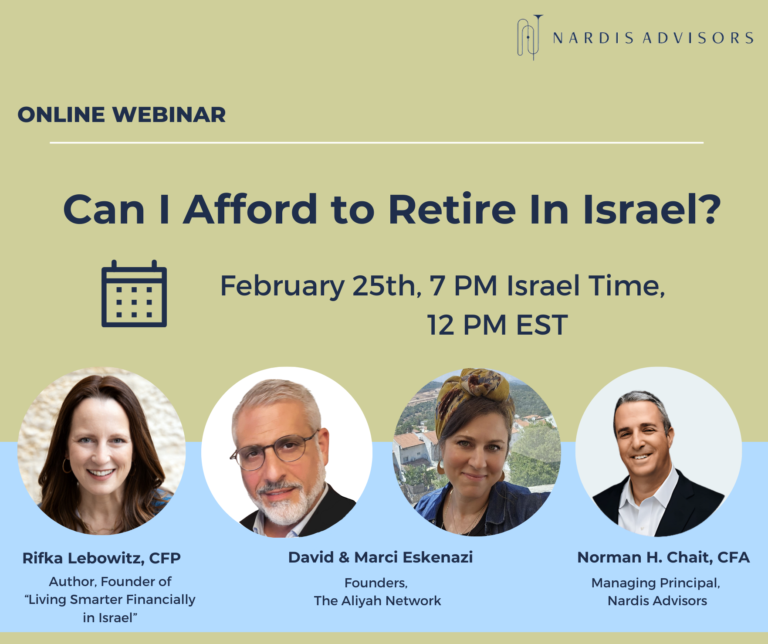
Can I Afford to Retire in Israel? – Key Questions, Answers and Insights Living in Israel as an American ImmigrantOn February 25 Webinar we held a Webinar entitled “Can I Afford to Retire in Israel”. The panel consisted of Rifka Lebowitz– “Living Financially Stronger in Israel”, Marci and David Eskenazi- “The Aliyah Network”, alongside Norman Chait and Mike Reed of Nardis Advisors. Here is a summary of the issues that were most important to…