


In this article we are going to discuss our outlook on the 2023 bond market and the key dynamics in play.
How does the change in yields to maturity impact the expected returns of bonds in the next 12 months? The yield to maturity is the average annual yield of the bond until it becomes due.
Longer term bonds are more sensitive to interest rates
The shorter the average life of the bond, the closer the yield to maturity is to the actual annual interest paid on the bond. However, longer duration bonds are more influenced in the short term by the current level of interest rates. And sometimes price fluctuations can be extreme when interest rates are changed.
For example, if we invest $100,000 in a one-year Treasury bond now, at an interest rate of 5.25%, we will earn $5,250 in 12 months’ time, as the bond matures and is redeemed.
If we invest for a period of more than a year, then the return we earn is influenced more by the level of interest rates in the market. Remember as interest the rates rise, bond prices drop, and vice versa.
The table below dated Oct 13, 2023 (source Bloomberg) shows during the current period how much one can gain or lose in the next 12 months, given:
- The term of the Treasury bond selected.
- The rise or fall of short-term interest rates.
The longer the duration of the bonds, the greater the potential fluctuation of the coming 12 months.
| 1.5% rate rise | 3% rate rise | 1.5% rate rise | 0.5% rate rise | 0.5% rate drop | 1.5% rate drop | 3% rate drop |
| 2-yr | 2.3% | 3.7% | 4.6% | 5.5% | 6.5% | 7.9% |
| 5-yr | -5.5% | -0.6% | 2.9% | 6.6% | 10.2% | 16.1% |
| 10-yr | -14.9% | -5.8% | 1.0% | 8.3% | 16.4% | 29.8% |
| 20-yr | -24.7% | -11.6% | -1.1% | 11.4% | 26% | 53.2% |
| 30-yr | -30.4% | -15.7% | -2.9% | 13.2% | 33.5% | 74.7% |
Currently, we see that the risk reward in the bond market is skewed towards the upside. In other words, for a given maturity and a given change in interest rates, one makes more when interest rates drop than when they rise.
So, for example, a rise of 150 basis points (1.5%) in interest rates would cause the 10-year Treasury to lose 5.8%, in the coming year, but if rates fell by a similar amount the same bond would earn 16.4%. For perspective, ten-year treasury yields have widened approximately 120 basis points so far this year. So, a 150 basis point move in the opposite direction is not an unreasonable possibility.
Bonds are now trading at some of the highest yield levels in 20 years. We believe this may be an attractive time to invest in the bond market, because:
- One earns high interest (coupons).
- We believe that the interest rate cycle may be near its peak – however we have less visibility as to whether rates are likely to remain at current levels, or drop in the near to medium term.
- If there is indeed a slowdown in the economy, then rates could drop, causing bond prices to rise.
- While we are not forecasting where interest rates will be in 12 months’ time, investors may who believe that rates will drop, may be able to reap a positive outcome on a risk-reward basis, especially in longer maturity bonds.
Getting help navigating the 2023 bond market
We are expat financial advisors located in Israel and the US, serving expats globally.
If you are moving to Israel or another country and don’t know where to start when it comes to the financial side of things, or hold US or foreign assets and need help figuring out your retirement as an expat, please contact us.
Have questions about retiring in Israel? We’re having a series of webinars in 2024 on this topic. We’re also publishing blogs on this subject.
JOIN the newsletter list here to stay informed.
Disclaimer
Nardis Advisors LLC (“Nardis”) is a Registered Investment Advisory Firm regulated by the U.S Securities and Exchange Commission in accordance and compliance with applicable securities laws and regulations. Registration does not imply a certain level of skill or training. Nardis does not render or offer to render personalized investment advice through this medium. The information provided herein is for informational purposes only and does not constitute financial, investment or legal advice. Investment advice can only be rendered after delivery of the Firm’s disclosure statement (Form ADV Part 2) and execution of an investment advisory agreement between the client and Nardis.
Subscribe to Our Newsletter
Stay up to date and receive the latest from Nardis, with resources such as our monthly blog and access to complimentary webinars.-
 April 17, 2026|
- Case Studies
- |
- Expats
Discovering the Retirement Account of a Deceased SpouseWe welcomed a new client who had moved back to Israel from the US after the passing of her husband. Morgan Stanley could no longer hold her Individual Retirement Account (IRA). We transferred this to Pershing, our primary custodian and began to manage the account. The couple had worked for over ten years in the… -
 April 17, 2026|
- Case Studies
- |
- Expats
The Tale of the Gold BarsWe welcomed a new client in 2025, who is a US citizen living in Israel, following the retirement of her 95-year old advisor. The majority of the assets are custodied with one of our current custodians, so no asset transfer was necessary. However, the client noted that she holds some physical gold bars in storage… -
 April 16, 2026|
- Articles
- |
- Expats
13 Social Security Facts For 2026In the spirit if the penultimate song in the Passover Haggadah, here is a fresh look at some key aspects of Social Security for US expats living in Israel. But first, if you’re new to life in Israel, check out our other helpful reads on moving abroad, cross-border finances, and tax-smart planning for expats: What… -
 April 15, 2026|
- Articles
- |
- Expats
Kicked Out of Your US Brokerage Account? Here’s What You Can Do:Can I continue to hold my US brokerage and retirement accounts once I leave the US to move overseas ? The good news is that in principle, not only can you keep your US brokerage account with a US bank or custodian, but in most circumstances it makes sense to do so, especially in the…
Explore More Articles
-
 March 28, 2026|
- Articles
- |
- Expats
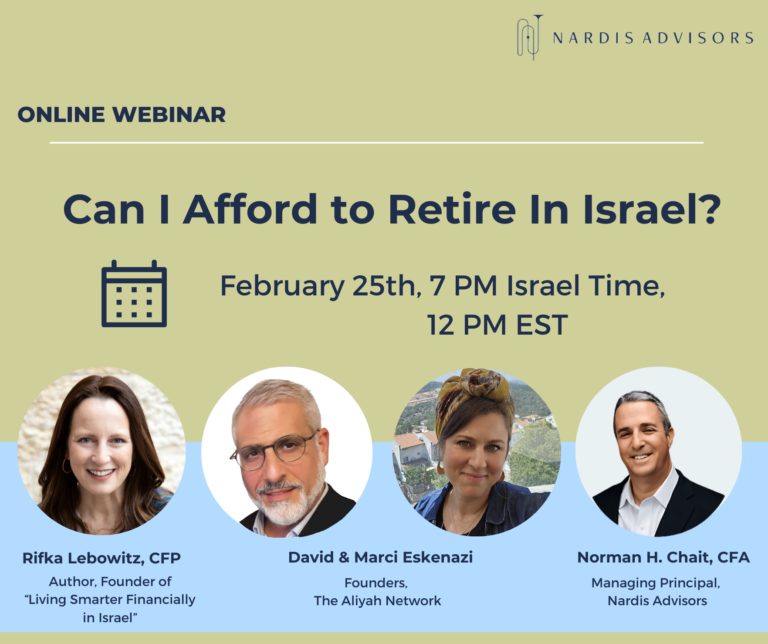
Can I Afford to Retire in Israel? – Key Questions, Answers and Insights Living in Israel as an American ImmigrantOn February 25 Webinar we held a Webinar entitled “Can I Afford to Retire in Israel”. The panel consisted of Rifka Lebowitz– “Living Financially Stronger in Israel”, Marci and David Eskenazi- “The Aliyah Network”, alongside Norman Chait and Mike Reed of Nardis Advisors. Here is a summary of the issues that were most important to… -
 February 10, 2026|
- Articles
- |
- Expats
Living in Israel as an American ImmigrantI’m a U.S. citizen and investment advisor who spent 23 years in New York building a business, Nardis Advisors, that’s still proudly headquartered there. But in 2016, I made the move back to Israel for deeply personal and family reasons. This article isn’t about urging you to pack up and move tomorrow. It’s simply a… -
 January 29, 2026|
- Articles
- |
- Expats
Should You Worry About the Strong Shekel? A Financial Reality Check for Americans Making AliyahMoney moves emotions, and nothing seems to stir those emotions more than exchange rates. Lately, many of my American clients eyeing a move to Israel, or preparing to transfer funds here, are alarmed by the shekel’s recent rally. A year ago, the dollar hovered around ₪3.60–3.70. Today, it’s near ₪3.09. That’s a 15% appreciation of…