

If you live in Israel and hold U.S. bank or brokerage accounts, your family may not be able to reach those
assets when you die unless you plan ahead. Beneficiary designations, joint accounts and U.S. mailing
addresses often don’t protect you the way people expect.
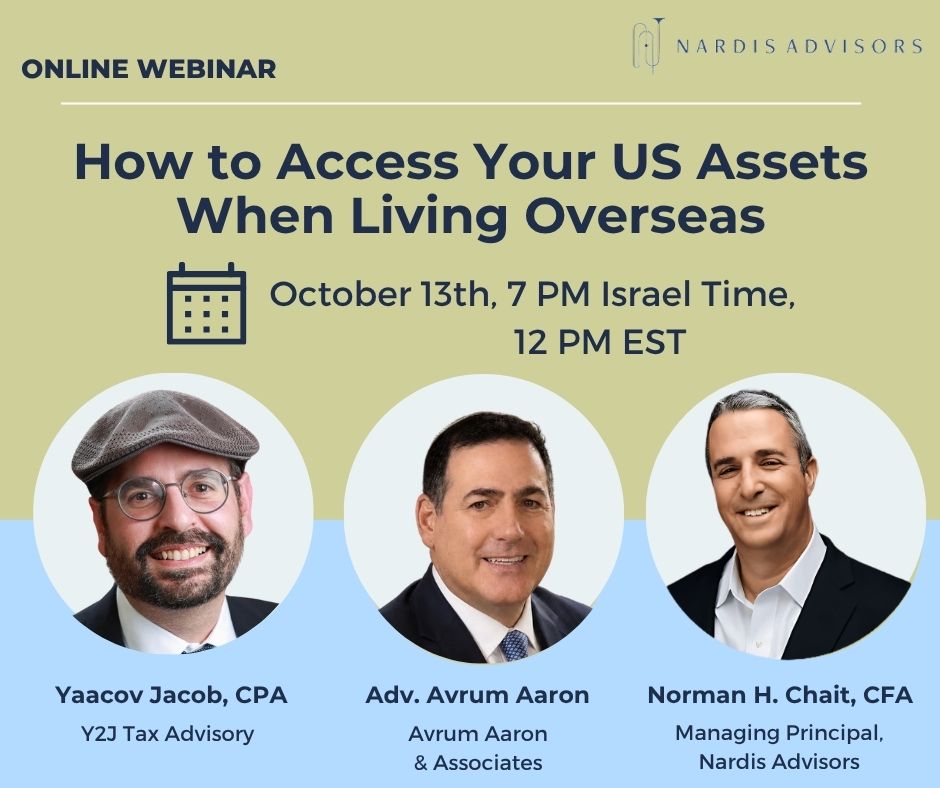
These are the 10 most common questions from our October 13, 2026 webinar, How to Access Your U.S.
Assets and Information While Living Overseas, answered by our panel:
- Adv. Avrum Aaron, Avrum Aaron & Associates. Avrum has more than 30 years of experience in
tax, estate planning, finance and commercial law. His practice focuses on U.S. trusts, estate
planning and cross-border asset planning for Americans living in Israel. He holds a J.D. from
Columbia Law School and an LL.M. in Taxation from NYU School of Law.
- Yaacov Jacob, CPA, Y2J Tax Advisory. Yaacov is an, Israel-based, US-licensed CPA with more than
15 years of experience in U.S. tax preparation and advisory for Americans living abroad. His
boutique practice serves Americans in Israel.
- Norman H. Chait, CFA, Managing Principal, Nardis Advisors. Norman leads Nardis Advisors, an
independent Registered Investment Advisor based in Scarsdale, NY, and Tel Aviv, Israel, that
builds custom portfolios for U.S. citizens living overseas. He has 31 years of investment
experience and is also a licensed portfolio manager in Israel. He holds an MBA from Columbia
University and a law degree from the Hebrew University of Jerusalem, and lives in Zichron
Ya’akov.
- Why do U.S. accounts get frozen when the owner dies?
Short answer: When an account holder dies, the brokerage’s compliance team freezes the account to
protect itself. If funds leave the account before any U.S. estate tax is paid, the firm can be held liable.
Holding the accounts in a revocable living trust is the most reliable way to avoid a freeze.
What our experts said:
- Avrum: When an account holder dies, the compliance department at the brokerage firm gets
involved. Their concern is to make sure they don’t have any liability by transferring these shares
to another person. If the funds are transferred out of the account and estate tax is owed by the
original account holder, the brokerage firm can be liable under the Internal Revenue Code. The
best way to solve this is by putting the accounts into a revocable living trust.
- Yaacov: One reason an account may be frozen is the IRS’s concern that the funds could be
withdrawn before any estate tax is paid. For example, suppose Jill is a non-U.S. person whose
estate is subject to U.S. estate tax. If her husband, Tom, lives abroad and withdraws the money
after her death but before the estate pays the tax, collecting that tax from overseas becomes
much more difficult for the IRS.
- Are TOD and POD beneficiary designations valid if I live in Israel?
Short answer: Don’t count on them. Many U.S. brokerages won’t honor Transfer on Death (TOD) or
Payable on Death (POD) designations for account holders who live outside the U.S. Expect TOD, POD and
Joint Tenants with Right of Survivorship (JTWROS) accounts to be frozen.
What our experts said:
- Avrum: It depends on the brokerage firm, but it is best not to rely on these, as brokerage firms
will disavow them for non-U.S. residents. The issue is that a non-U.S. resident will likely have his
estate adjudicated in a foreign court. The brokerage firms do not want to deal with a situation
where a foreign court gives an order that contradicts a TOD. Therefore, they just disavow the
TOD when you live outside the U.S. Some firms, like Merrill Lynch, are very upfront about this.
Others don’t tell you the situation until it’s too late.
- Norman: Best to assume that TOD/POD and JTWROS accounts will be frozen by the U.S.
custodian for U.S. citizens living overseas.
- What is an IRS transfer certificate, and do my heirs need one?
Short answer: An IRS transfer certificate confirms that no U.S. estate tax is still owed, so a bank or
brokerage can release the funds. If the account holder died in Israel or anywhere outside the U.S.,
expect it to be required, even if the account used a U.S. address. The wait for one can be very long.
What our experts said:
- Avrum: An IRS transfer certificate is the IRS telling brokerage firms and banks that estate tax
obligations are something they no longer need to worry about. Whether you use a U.S. address
or not will not save you from having to get one of these if the brokerage firm decides you need
one.
- Yaacov: Using a U.S. mailing address does not change the account owner’s status. A transfer
certificate is the IRS’s approval confirming that no estate tax remains due before the funds are
released. This process used to take months, but since COVID, the wait can be extremely long.
- Norman: It is required if the decedent passed away in Israel or outside the U.S., irrespective of
what address he or she used.
- If I have a will and named beneficiaries, do my assets skip probate?
Short answer: No. A will always goes through probate before it takes effect, in Israel and in the U.S. And
U.S. brokerages may not honor named beneficiaries for someone who dies as a non-U.S. resident. A
revocable living trust is the usual way to keep assets out of probate.
What our experts said:
- Avrum: A will will always be probated to take effect. There’s no way that anyone with
substantial assets can avoid probate in Israel. In the U.S., it is very likely that a brokerage firm
will not honor TODs or PODs when the decedent passes as a non-U.S. resident.
- Yaacov: A will does not bypass probate. A revocable living trust is commonly used for that
purpose.
- Can I set up a U.S. trust while living in Israel?
Short answer: Yes. A U.S. trust can be set up while you live in Israel, and the trustees don’t need to live
in the U.S.
What our experts said:
- Avrum: A U.S. trust can be established in Israel. The trustees need to be U.S. citizens. They do
not need to reside in the U.S.
- Do I have to report a U.S. revocable trust to the Israel Tax Authority?
Short answer: Yes. A revocable trust usually doesn’t create extra Israeli tax, but it must be reported to
the Israel Tax Authority (Mas Hachnasah) and the filing kept up to date. Irrevocable and non-grantor
trusts are taxed very differently in both countries.
What our experts said:
- Yaacov: Usually, establishing a revocable trust does not create additional tax in Israel, but the
trust still needs to be reported. At a minimum, there is an informational filing requirement, and
that reporting needs to be kept up to date. Irrevocable and non-grantor trusts are an entirely
different beast and do change Israeli and U.S. taxation significantly.
- Why won’t some U.S. brokerages let Israeli residents buy CDs?
Short answer: Each brokerage sets its own rules on what non-U.S. residents can buy, and some may
restrict products such as CDs. Money-market ETFs and short-term Treasury bonds are common
alternatives.
What our experts said:
- Norman: Each custodian has its own rules as to what products a non-U.S. resident can and
cannot purchase. There are plenty of substitute products one can invest in instead of CDs, such
as money-market ETFs and short-term Treasury bonds.
- Do I need separate powers of attorney for the U.S. and Israel?
Short answer: Yes. A power of attorney (POA) is a legal document that lets someone handle your affairs.
In practice, POAs don’t work well across borders, so set one up in each country, or include the same
authority in your trust. Some U.S. brokerages also require their own POA form.
What our experts said:
- Avrum: A power of attorney is simply the formal legal document saying that this person (the
attorney) can handle one’s affairs. Powers of attorney can be general or limited to very specific
situations. You can have as many as you want. Some brokerage firms actually require you to use
their own forms. You do not want to be in a situation where you’re trying to use an Israeli power
of attorney in the U.S. or a U.S. power of attorney in Israel. Although theoretically that should
work, practically, it’s a series of headaches that over-the-counter medications will not cure.
- Norman: POAs do not cross borders, so it is essential to set up a POA (or equivalent stipulation
in a trust) in each country.
- Can I keep using my ID.me account after moving to Israel?
Short answer: Yes. Your ID.me account stays with you when you move abroad, and you can verify it with
either a U.S. or an Israeli address. The address on your tax return is a separate decision. In some cases,
using your Israeli address helps.
What our experts said:
- Yaacov: Your existing ID.me account is personal to you and stays with you when you move
abroad. Either a U.S. or an Israeli address can be used for verification. A separate, important
question is which address appears on your tax return. Many people use an old U.S. address or a
family member’s address so that they can reliably receive mail. Using a foreign address may lead
to additional identity checks, and having an ID.me account can help resolve those. There are
some times though, where I would stress the importance of using a foreign address on your tax
return. For example, over the past three years, using an Israeli address rather than a U.S.
address has made it easier to establish eligibility for applicable interest and penalty relief.
- Are gifts or inheritances sent to someone in Israel taxed in the U.S.?
Short answer: Moving money overseas isn’t a taxable event on its own. But a U.S. person giving gifts
often has to file with the IRS, and very large gifts (in the millions) can be taxed. A U.S. person who
receives a gift or inheritance from a non-U.S. person may also have to file.
What our experts said:
- Yaacov: Moving funds overseas does not create a taxable event. Giving gifts, if you are a U.S.
person, does often create filing requirements, and if they are millions of dollars, can create a
taxable event. Receiving an inheritance or gift from a non-U.S. person can also create a filing
requirement for the U.S. person receiving the gift or inheritance.
Get help planning for your U.S. assets.
Every family’s situation is different.
Watch the full webinar recording or book a consultation with our team to review your accounts, trust options and filing requirements.
This article is for general information only and isn’t legal, tax or investment advice. Speak with a qualified professional about your own situation.
Disclaimer
Nardis Advisors LLC (“Nardis”) is a Registered Investment Advisory Firm regulated by the U.S Securities and Exchange Commission in accordance and compliance with applicable securities laws and regulations. Registration does not imply a certain level of skill or training. Nardis does not render or offer to render personalized investment advice through this medium. The information provided herein is for informational purposes only and does not constitute financial, investment or legal advice. Investment advice can only be rendered after delivery of the Firm’s disclosure statement (Form ADV Part 2) and execution of an investment advisory agreement between the client and Nardis.
Subscribe to Our Newsletter
Stay up to date and receive the latest from Nardis, with resources such as our monthly blog and access to complimentary webinars.-
 November 13, 2026|
- Expats
How to Access Your US Assets While Living In Israel: 10 Questions AnsweredIf you live in Israel and hold U.S. bank or brokerage accounts, your family may not be able to reach thoseassets when you die unless you plan ahead. Beneficiary designations, joint accounts and U.S. mailingaddresses often don’t protect you the way people expect. These are the 10 most common questions from our October 13, 2026… -
 October 21, 2026|
- Expats
What Happens to Your Retirement Money When You Move Abroad?Retirement abroad can mean a new country, a different lifestyle, and perhaps a lower cost of living. But while you may be ready to cross borders, much of your retirement money may remain firmly connected to the United States. Your Social Security benefits, old 401(k)s, and IRAs don’t simply disappear when you move. What can… -
 August 18, 2026|
- Expats
- |
- Investing
The Three Times U.S. Expats Need Access to Their Money MostYou’ve spent years building your wealth. But have you ever stopped to ask a simple question: Will you, and your family, be able to access it when it matters most? For many U.S. expats, the biggest risks aren’t poor investment returns. They’re the unexpected obstacles that can arise when you move overseas, lose the ability… -
 June 16, 2026|
- The Dreidel
The Dreidel –June 2026 EditionDear fellow practitioners, CPAs, attorneys, and other professionals, welcome to the twentieth edition of our “Dreidel” newsletter about planning and investment issues of US citizens living overseas. This month Mike Reed will cover a little-known Social Security rule that could have a large impact for couples living in Israel – specifically for couples where one…
Explore More Articles
-
 April 17, 2026|
- Case Studies
- |
- Expats
Discovering the Retirement Account of a Deceased SpouseWe welcomed a new client who had moved back to Israel from the US after the passing of her husband. Morgan Stanley could no longer hold her Individual Retirement Account (IRA). We transferred this to Pershing, our primary custodian and began to manage the account. The couple had worked for over ten years in the… -
 April 17, 2026|
- Case Studies
- |
- Expats
The Tale of the Gold BarsWe welcomed a new client in 2025, who is a US citizen living in Israel, following the retirement of her 95-year old advisor. The majority of the assets are custodied with one of our current custodians, so no asset transfer was necessary. However, the client noted that she holds some physical gold bars in storage… -
 April 16, 2026|
- Articles
- |
- Expats
13 Social Security Facts For 2026In the spirit if the penultimate song in the Passover Haggadah, here is a fresh look at some key aspects of Social Security for US expats living in Israel. But first, if you’re new to life in Israel, check out our other helpful reads on moving abroad, cross-border finances, and tax-smart planning for expats: What…